We provide 24/7 client support for all acoustic solutions, addressing queries, guidance, and service needs anytime, ensuring complete satisfaction.
Envirco Solutions - Architectural Acoustics Treatments & Noise Pollution Control Solution
We'are Open: Mon - Sat 9:00 - 19:00

- 24/7
Customer Service
- ISO 9001
Certification Company
- Qualified
Expert Professional

Modern Acoustic Ceiling Cloud Solutions for Large Open Spaces
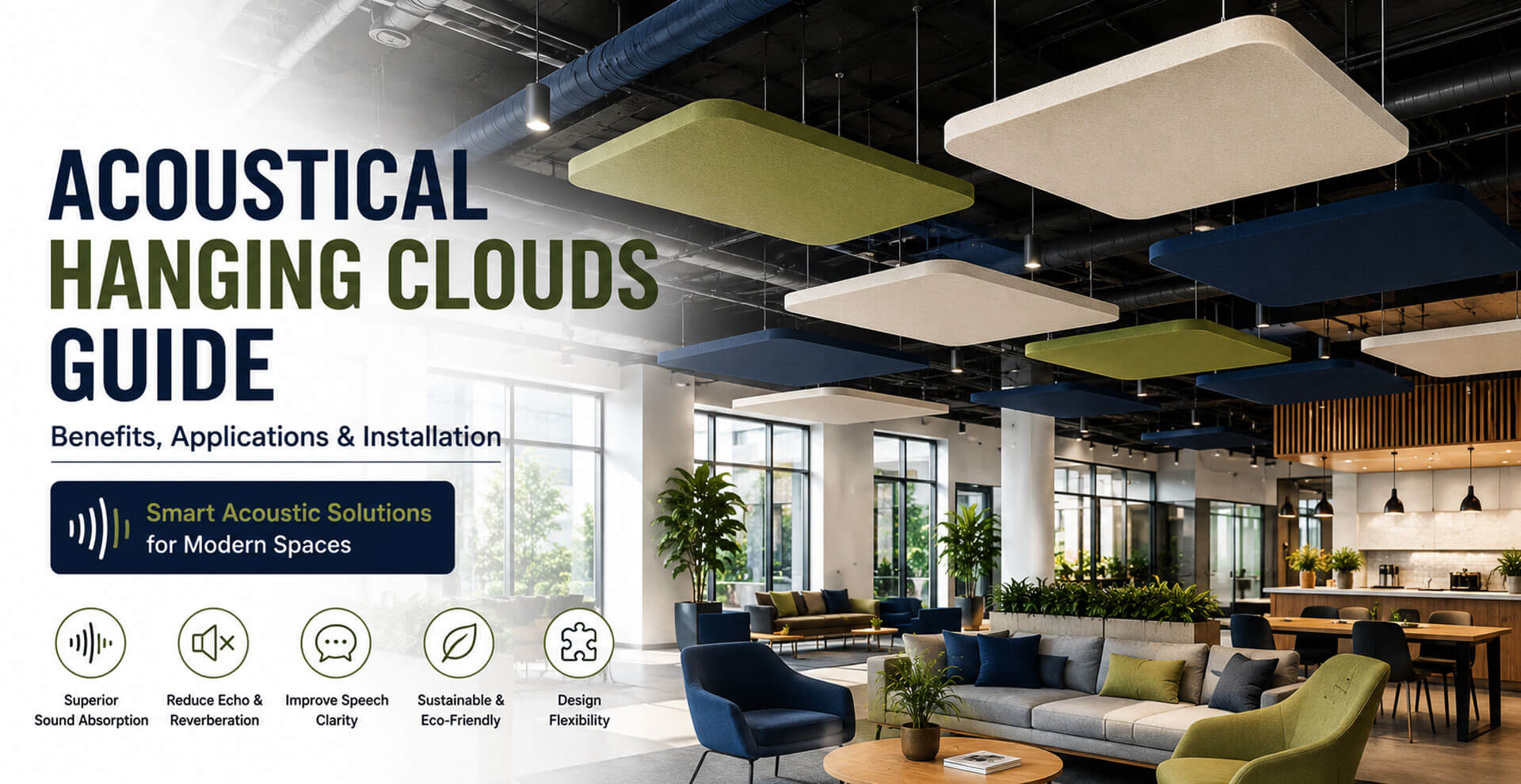
Acoustical Hanging Clouds: Benefits, Applications & Installation Guide
Modern architectural spaces increasingly feature open ceilings, exposed structures, glass walls and collaborative interior layouts. While these designs create attractive and flexible environments, large areas of hard surfaces can also contribute to excessive reverberation, echo and unwanted background noise. These acoustic issues can affect speech clarity, concentration and overall occupant comfort.
Acoustical hanging clouds, also known as acoustic ceiling clouds or acoustic hanging clouds, provide an effective way to control reflected sound without completely covering the ceiling. Suspended below the structural ceiling, these sound-absorbing panels combine acoustic treatment with a distinctive architectural appearance.
Acoustic cloud systems are commonly considered for offices, auditoriums, classrooms, universities, healthcare facilities, restaurants, commercial buildings and other large interior spaces where controlling reverberation is important. Depending on the project, they can be combined with ceiling acoustic panels, acoustic wall panels, fabric acoustic panels and acoustic hanging baffles to develop a more complete room-acoustic treatment strategy.
This guide explains what acoustical hanging clouds are, how they work, their benefits, different types, applications, acoustic performance considerations, design factors and common installation methods.
What Are Acoustical Hanging Clouds?
Acoustical hanging clouds are suspended sound-absorbing panels installed below a structural ceiling to help control reflected sound and reduce reverberation. Unlike a conventional suspended ceiling, an acoustic cloud does not need to cover the entire ceiling plane. Instead, individual panels are positioned strategically within the room to provide additional sound absorption where it is required.
Because the panels are suspended below the main ceiling, both the visible face and the space around the panel can contribute to sound absorption. The air gap between the cloud and the structural ceiling can also influence acoustic performance, depending on the panel construction, thickness, suspension height and overall room conditions.
This makes acoustic hanging clouds particularly useful in spaces where the architectural design calls for an exposed ceiling while additional acoustic treatment is still required.
Acoustic clouds can be manufactured or finished using different sound-absorbing materials, including:
- Fiberglass acoustic cores
- Polyester fibre acoustic panels
- Fabric-wrapped acoustic systems
- Mineral wool acoustic materials
- Wood-based acoustic systems
- Other acoustic composite materials
They can also be produced in different shapes and configurations, including:
- Rectangular acoustic clouds
- Square acoustic clouds
- Circular acoustic clouds
- Hexagonal acoustic clouds
- Custom architectural shapes
These design options allow architects, interior designers and acoustic consultants to integrate acoustic treatment into the overall ceiling concept rather than treating it as a separate visual element.
How Do Acoustical Hanging Clouds Work?
To understand the purpose of acoustical hanging clouds, it is important to consider how sound behaves inside an enclosed or semi-enclosed space.
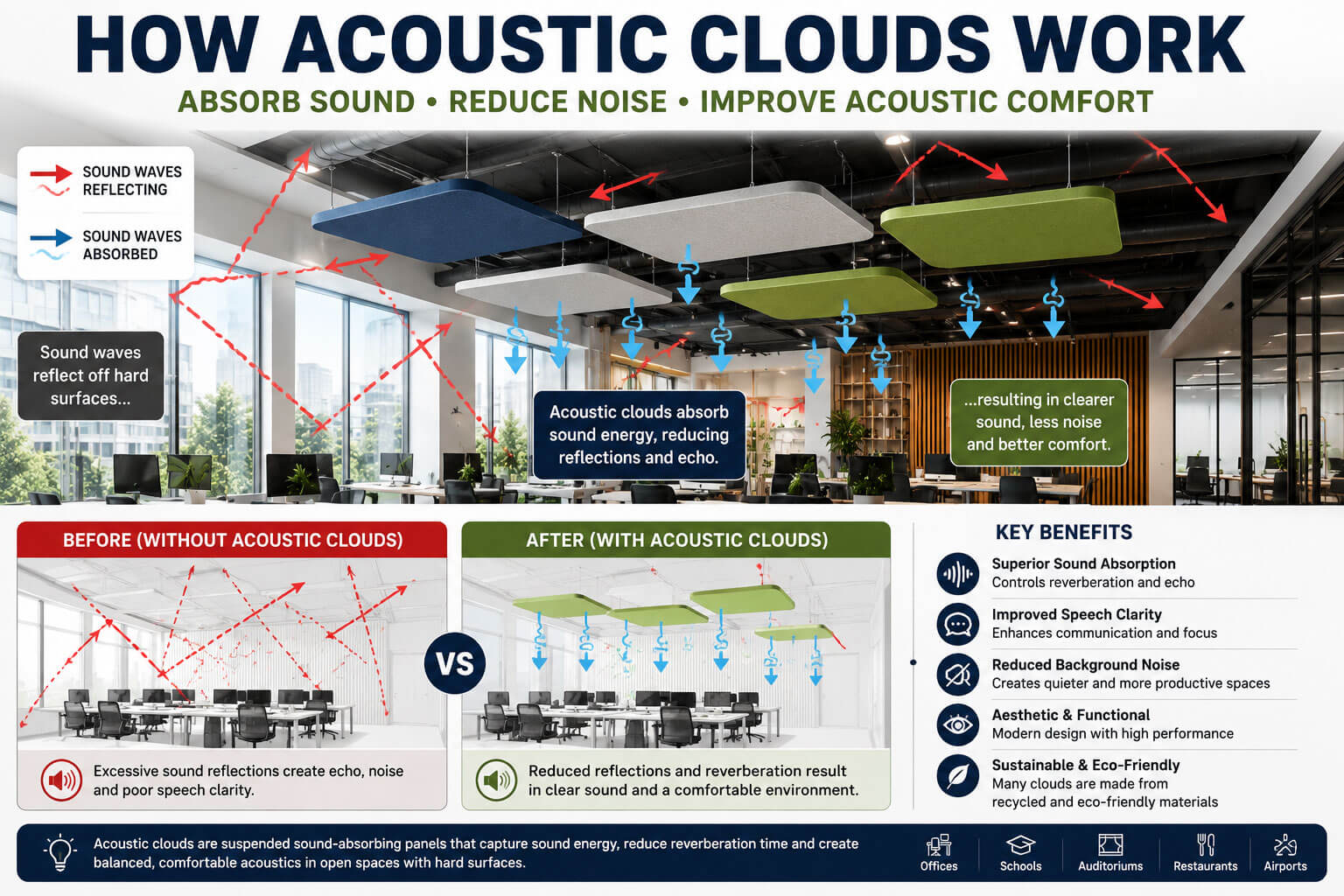
Speech, music, equipment and other sound sources generate sound waves that travel through a room. When these waves encounter hard surfaces such as concrete walls, glass, tiled floors and exposed ceilings, they can reflect back into the space. Multiple reflections can increase reverberation and make speech or other sounds more difficult to understand.
This can be particularly noticeable in large rooms with high ceilings and extensive hard finishes. Common acoustic problems include:
- Reduced speech intelligibility
- Excessive reverberation
- Audible echo
- Increased perceived background noise
- Difficulty communicating in busy spaces
- Reduced acoustic comfort
Acoustical hanging clouds help by absorbing a portion of the reflected sound energy before it continues to bounce around the room. The acoustic core of the panel converts part of the sound energy into a small amount of heat, thereby reducing reflected sound within the treated area.
The effectiveness of an acoustic cloud depends on several factors, including the material, thickness, exposed surface area, suspension height, spacing, room volume and overall acoustic treatment strategy.
Key Benefits of Acoustical Hanging Clouds
Effective Sound Absorption
The primary purpose of acoustical hanging clouds is to absorb reflected sound and help reduce reverberation. Properly selected and positioned acoustic clouds can contribute to a more balanced acoustic environment for communication, learning, collaboration and other activities.
Acoustic performance varies according to the construction and specification of the panel. For projects with defined acoustic requirements, product test data and the required acoustic performance should be considered during selection.
Improved Speech Clarity
Speech intelligibility is important in offices, classrooms, conference rooms, lecture halls and public spaces. Excessive reflected sound can make speech less clear because sound continues to arrive at the listener from multiple directions and at different times.
By reducing reflected sound and reverberation, acoustic clouds can help create conditions in which conversations, presentations and announcements are easier to hear.
Reduced Echo and Reverberation
Large rooms with high ceilings and hard interior surfaces can experience significant reverberation. Acoustic cloud panels provide additional absorption within the ceiling zone, helping reduce excessive reflections and improve the acoustic character of the room.
Preservation of Open Ceiling Design
One of the major architectural advantages of acoustic hanging clouds is that they can improve room acoustics without requiring the entire structural ceiling to be concealed. This makes them suitable for interiors where exposed services, open ceilings and contemporary architectural finishes are part of the design.
Architectural Flexibility
Acoustic clouds are available in different shapes, sizes, colours, finishes and configurations. This allows designers to create a ceiling composition that supports both the acoustic requirements and the visual language of the interior.
Suitable for Large and Open Interior Spaces
Acoustic hanging clouds can be particularly useful in large open areas where ceiling height, hard surfaces and room volume make conventional surface-mounted acoustic treatment insufficient on its own. Suspended acoustic elements can help absorb reflected sound from above while also providing a practical solution for spaces with exposed or high ceilings. They are suitable for offices, auditoriums, educational facilities, commercial interiors and other large environments where controlling reverberation and improving acoustic comfort are important. For a broader look at applications, design options and installation considerations, explore our acoustic ceiling cloud solutions for large open spaces.
Integration with Other Acoustic Treatments
Acoustic clouds do not necessarily have to work as a standalone treatment. Depending on the room, they can be combined with wall panels, ceiling panels, acoustic tiles and hanging baffles to address reflections from different surfaces.
Types of Acoustical Hanging Clouds
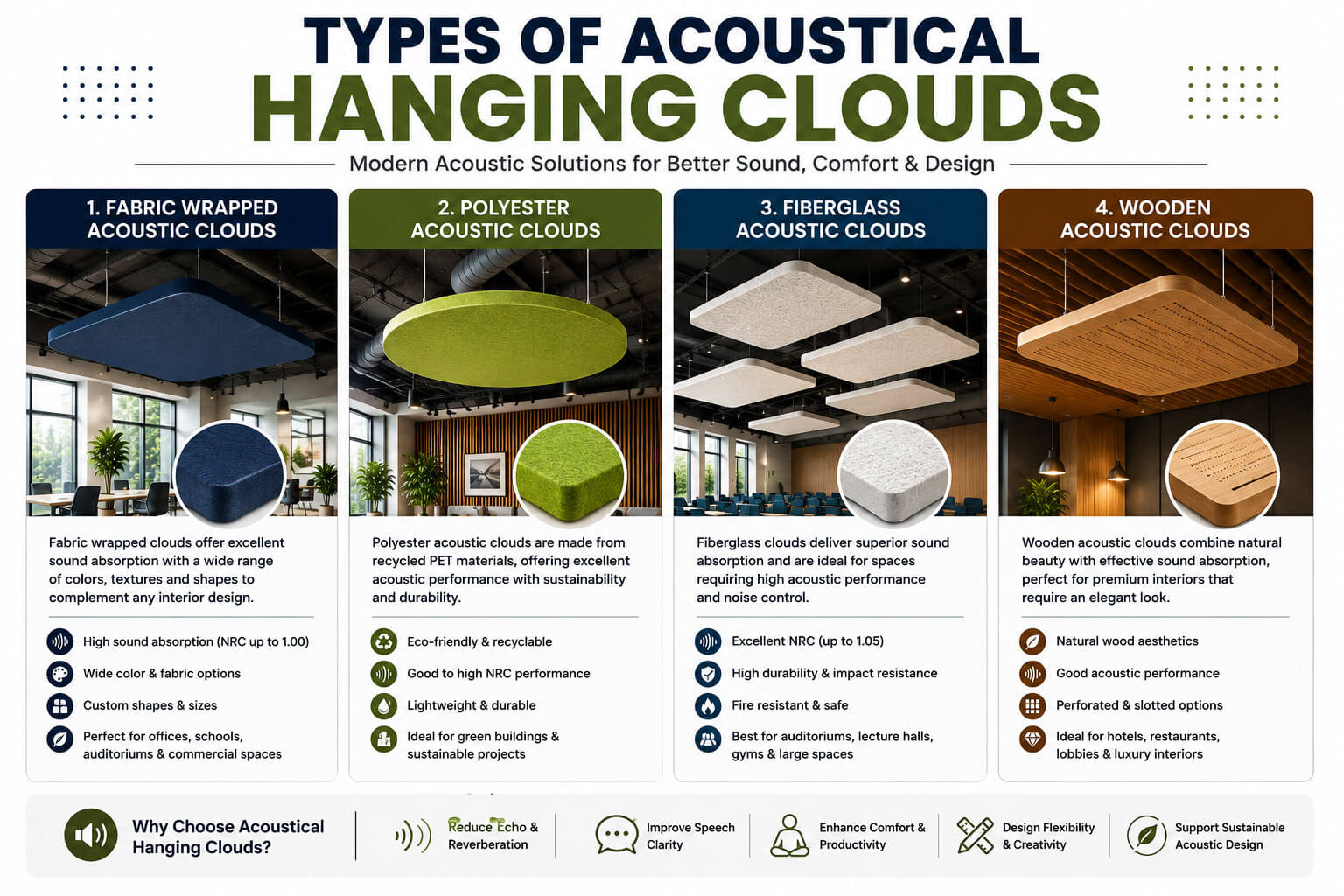
Fabric Wrapped Acoustic Clouds
Fabric-wrapped acoustic clouds are widely used where sound absorption needs to be combined with a decorative interior finish. These systems generally consist of an acoustic core covered with an acoustically suitable fabric available in different colours and textures.
Depending on the product specification, fabric-wrapped acoustic clouds can offer:
- Sound absorption
- A wide choice of fabric colours
- Custom sizes and shapes
- Architectural design flexibility
- Integration with modern commercial interiors
Polyester Acoustic Clouds
Polyester acoustic clouds can be manufactured using PET-based acoustic materials. They are suitable for projects where lightweight acoustic treatment, design flexibility and material sustainability are important considerations.
Fiberglass Acoustic Clouds
Fiberglass-based acoustic clouds are designed for applications requiring effective sound absorption. They can be considered for auditoriums, educational facilities, offices, commercial interiors and other spaces where reverberation control is an important design requirement.
Wooden Acoustic Clouds
Wooden acoustic clouds provide an architectural alternative for projects where a natural or premium wood finish is desired. They can be coordinated with other timber-based acoustic treatments such as wooden acoustic ceiling tiles to create a consistent interior design.
Applications of Acoustical Hanging Clouds
Acoustical hanging clouds can be used across a wide range of building types. Their ability to provide additional sound absorption while retaining an open ceiling appearance makes them suitable for both new construction and renovation projects.
Corporate Offices
Open-plan offices often contain multiple simultaneous conversations, meetings and activities. Hard ceilings, glass and other reflective finishes can increase reverberation and make background noise more noticeable.
Acoustic ceiling clouds can provide additional absorption in the ceiling zone and can be combined with acoustic wall panels and fabric acoustic panels as part of a broader workplace acoustic strategy.
Auditoriums and Performance Spaces
Auditoriums require careful control of sound reflections so that speech, presentations and performances can be heard clearly throughout the audience area. Acoustic clouds can contribute to ceiling-level sound absorption when incorporated into an overall acoustic design.
They can be integrated with auditorium acoustic solutions and auditorium acoustic work where additional acoustic treatment is required.
Schools, Classrooms and Educational Institutions
Classrooms, lecture halls and training spaces depend on clear communication between teachers, students and speakers. Excessive reverberation can make speech harder to understand, particularly in rooms with high ceilings and reflective finishes.
Acoustic hanging clouds can help control reflected sound and contribute to a more suitable acoustic environment for teaching, presentations and group activities.
Restaurants and Cafes
Busy restaurants and cafes can experience significant background noise from conversations, kitchen equipment and hard interior surfaces. Ceiling-mounted acoustic clouds can add sound absorption while allowing the designer to retain an open and visually distinctive ceiling.
Healthcare Facilities
Healthcare environments require careful consideration of speech clarity, background noise and occupant comfort. Acoustic cloud systems can form part of a broader acoustic treatment strategy for waiting areas, consultation spaces, corridors and other suitable interior areas.
Airports and Transportation Hubs
Large transportation spaces often contain high ceilings and extensive reflective surfaces. Acoustic cloud systems can provide additional sound absorption and may support clearer communication in combination with other acoustic treatments.
Retail and Commercial Spaces
Shopping centres, showrooms, reception areas and other commercial interiors can benefit from improved acoustic comfort. Acoustic clouds allow designers to introduce sound absorption without necessarily closing off an exposed ceiling.
Acoustical Hanging Clouds vs Acoustic Hanging Baffles
Both acoustical hanging clouds and acoustic hanging baffles are suspended acoustic treatments, but their orientation and visual configuration are different. The appropriate solution depends on room geometry, acoustic requirements, ceiling height, available coverage area and architectural objectives.
| Feature | Acoustical Hanging Clouds | Acoustic Hanging Baffles |
|---|---|---|
| Typical Orientation | Horizontal or angled | Vertical |
| Visual Appearance | Floating ceiling elements | Suspended vertical elements |
| Design Approach | Broad ceiling-zone treatment | Linear or repeated suspended treatment |
| Common Applications | Offices, auditoriums, classrooms and commercial spaces | Open spaces, industrial areas, gyms and commercial interiors |
The two systems can also be used together when a project requires additional acoustic absorption in different areas of the room. Explore acoustic hanging baffles to understand the alternative suspended treatment.
NRC Ratings and Acoustic Performance
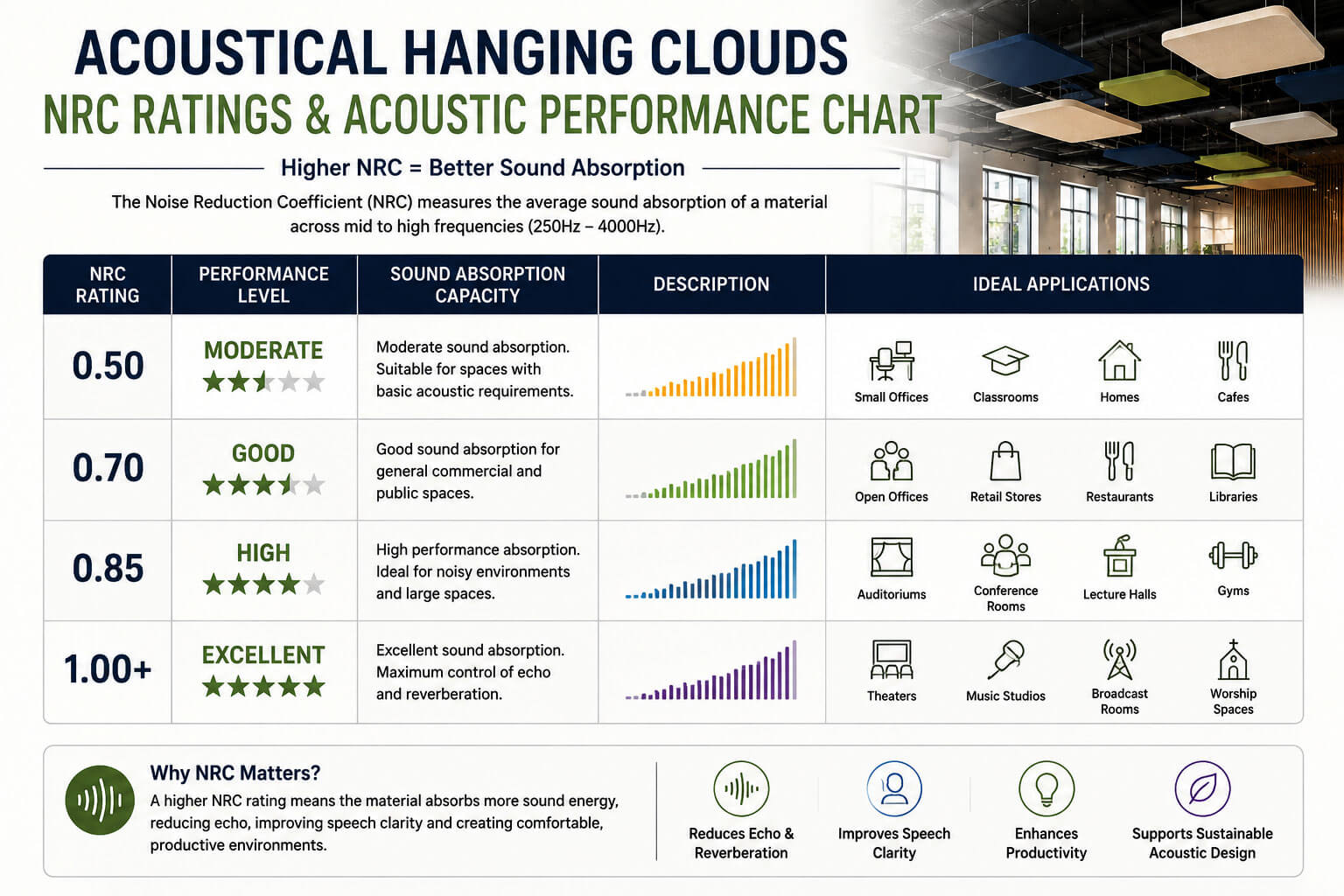
The Noise Reduction Coefficient (NRC) is one commonly used indicator when evaluating the sound absorption characteristics of acoustic materials. It provides a simplified representation of sound absorption across a defined range of frequencies.
A higher NRC generally indicates greater sound absorption under the relevant test conditions. However, NRC should not be considered the only factor when selecting an acoustic cloud system.
Actual acoustic performance can be influenced by:
- Panel thickness
- Acoustic core material
- Exposed surface area
- Suspension height
- Spacing between panels
- Room volume and geometry
- Existing wall and ceiling finishes
- Overall acoustic treatment coverage
For projects with specific acoustic targets, product test reports and project-specific acoustic calculations should be considered rather than relying on a generic NRC value alone.
Acoustic cloud systems can also be combined with ceiling acoustic panels and ceiling acoustic tiles to increase the overall amount of sound absorption within a room.
Design Considerations Before Installing Acoustic Clouds
Selecting and positioning acoustic hanging clouds requires more than simply choosing a visually attractive panel. The room's acoustic characteristics, ceiling height, occupancy and architectural requirements should all be considered.
Room Volume
Large rooms generally contain a greater volume of air and can require more acoustic absorption to achieve the desired reverberation characteristics. Room dimensions should therefore be considered when estimating the required acoustic treatment.
Ceiling Height
The height at which an acoustic cloud is suspended can influence its acoustic performance and visual appearance. Suspension height should be selected according to the panel specification, room geometry and project requirements.
Occupancy Levels
The number of occupants and the activities taking place within the space affect the acoustic environment. Offices, classrooms, restaurants and auditoriums may therefore require different acoustic treatment strategies.
Noise Sources
Identifying the main sources of noise is important before selecting an acoustic solution. Noise may come from conversations, equipment, presentations, music, mechanical systems or activities within adjacent spaces.
Architectural Objectives
Cloud shapes, colours, finishes and suspension layouts should complement the overall interior design. A well-planned acoustic ceiling can become an architectural feature while also providing useful sound absorption.
Installation Process of Acoustical Hanging Clouds
Professional installation is important for both the safety and intended performance of suspended acoustic systems. The exact installation method depends on the product construction, ceiling type, panel size and suspension hardware.
Step 1: Acoustic Assessment
An acoustic assessment helps identify excessive reverberation, reflective surfaces and other room-acoustic issues. The findings can be used to determine the type and approximate coverage of acoustic treatment required.
Step 2: Layout Planning
The cloud layout is planned according to room dimensions, ceiling height, furniture arrangement, architectural design and acoustic objectives. Panel size, spacing and orientation are considered at this stage.
Step 3: Suspension System Installation
Suspension cables, rods or other approved hardware are installed according to the product and project specifications. The supporting structure must be suitable for the weight and configuration of the suspended panels.
Step 4: Cloud Panel Installation
The acoustic cloud panels are mounted and aligned according to the approved layout. Careful positioning helps maintain a consistent visual appearance and the intended acoustic coverage.
Step 5: Final Inspection
The completed installation should be inspected to confirm panel alignment, suspension stability, finish quality and compliance with the project requirements.
Creating a Complete Acoustic Treatment Strategy
Acoustical hanging clouds can be highly effective, but the most appropriate acoustic treatment depends on the characteristics of the individual room. In many projects, ceiling treatment is combined with wall treatment and other acoustic products to address sound reflections from multiple surfaces.
Depending on the project requirements, related acoustic solutions may include:
- Acoustical Hanging Clouds
- Acoustic Hanging Baffles
- Ceiling Acoustic Panels
- Ceiling Acoustic Tiles
- Acoustic Wall Panels
- Fabric Acoustic Panels
- Wooden Acoustic Ceiling Tiles
- Auditorium Acoustic Solutions
The right combination of acoustic products can help control reverberation, improve speech intelligibility and create a more comfortable acoustic environment while maintaining the desired architectural appearance.
Frequently Asked Questions About Acoustical Hanging Clouds
What are acoustical hanging clouds?
Acoustical hanging clouds are suspended sound-absorbing panels installed below a structural ceiling to help reduce reflected sound and reverberation. They are commonly used where acoustic improvement is required without completely covering an exposed ceiling.
What are acoustic hanging clouds used for?
Acoustic hanging clouds are used to control reverberation and reflected sound in offices, auditoriums, classrooms, healthcare facilities, restaurants, airports, commercial spaces and other large interior environments.
Do acoustic clouds reduce echo?
Yes. By absorbing a portion of reflected sound energy, acoustic clouds can help reduce excessive reverberation and echo. The actual improvement depends on the room, panel specification, coverage and overall acoustic treatment.
What is the difference between acoustic clouds and acoustic baffles?
Acoustic clouds are generally installed horizontally or at an angle and create floating ceiling elements, while acoustic baffles are typically suspended vertically. Both can provide sound absorption, but the appropriate choice depends on the room and project requirements.
What NRC rating should I look for in acoustic clouds?
A suitable NRC depends on the acoustic requirements of the project. Higher sound absorption can be beneficial where reverberation needs to be reduced, but NRC should be evaluated together with panel thickness, coverage, suspension height, room geometry and other acoustic treatments.
Can acoustic clouds be customized?
Depending on the product and project requirements, acoustic clouds can be available in different shapes, sizes, colours, finishes and configurations. Customisation should be discussed according to the required acoustic performance and architectural design.
Are acoustic clouds suitable for open ceilings?
Yes. Acoustic hanging clouds are particularly useful for spaces where the exposed ceiling and building services are intended to remain visible while additional sound absorption is required.
Conclusion
Acoustical hanging clouds provide a practical way to introduce sound absorption into modern interiors while maintaining an open ceiling design. By reducing reflected sound and excessive reverberation, they can contribute to improved speech clarity and acoustic comfort in offices, auditoriums, educational facilities, healthcare environments, restaurants and commercial spaces.
The effectiveness of an acoustic cloud system depends on the panel construction, acoustic performance, coverage, suspension height, room characteristics and overall treatment strategy. For this reason, acoustic cloud selection should be based on the specific requirements of the project rather than appearance alone.
For projects requiring a combination of ceiling and wall acoustic treatment, Envirco Solutions also provides solutions including ceiling acoustic panels, acoustic wall panels, acoustic hanging baffles and fabric acoustic panels.
Choosing the appropriate combination of acoustic products can help create quieter, clearer and more comfortable interior environments while supporting the architectural design of the space.
Round-the-Clock Client Assistance
Creative Acoustic Designs
We deliver innovative acoustic solutions blending functionality and aesthetics, enhancing sound quality while elevating the visual appeal of any interior space.
Trusted Acoustic Safety
Our acoustic solutions ensure reliable safety, combining high-quality materials and expert installation to reduce noise hazards and protect every environment.