We provide 24/7 client support for all acoustic solutions, addressing queries, guidance, and service needs anytime, ensuring complete satisfaction.
Envirco Solutions - Architectural Acoustics Treatments & Noise Pollution Control Solution
We'are Open: Mon - Sat 9:00 - 19:00

- 24/7
Customer Service
- ISO 9001
Certification Company
- Qualified
Expert Professional

Premium Wooden Acoustic Baffles for Elegant Ceilings & Superior Sound Control
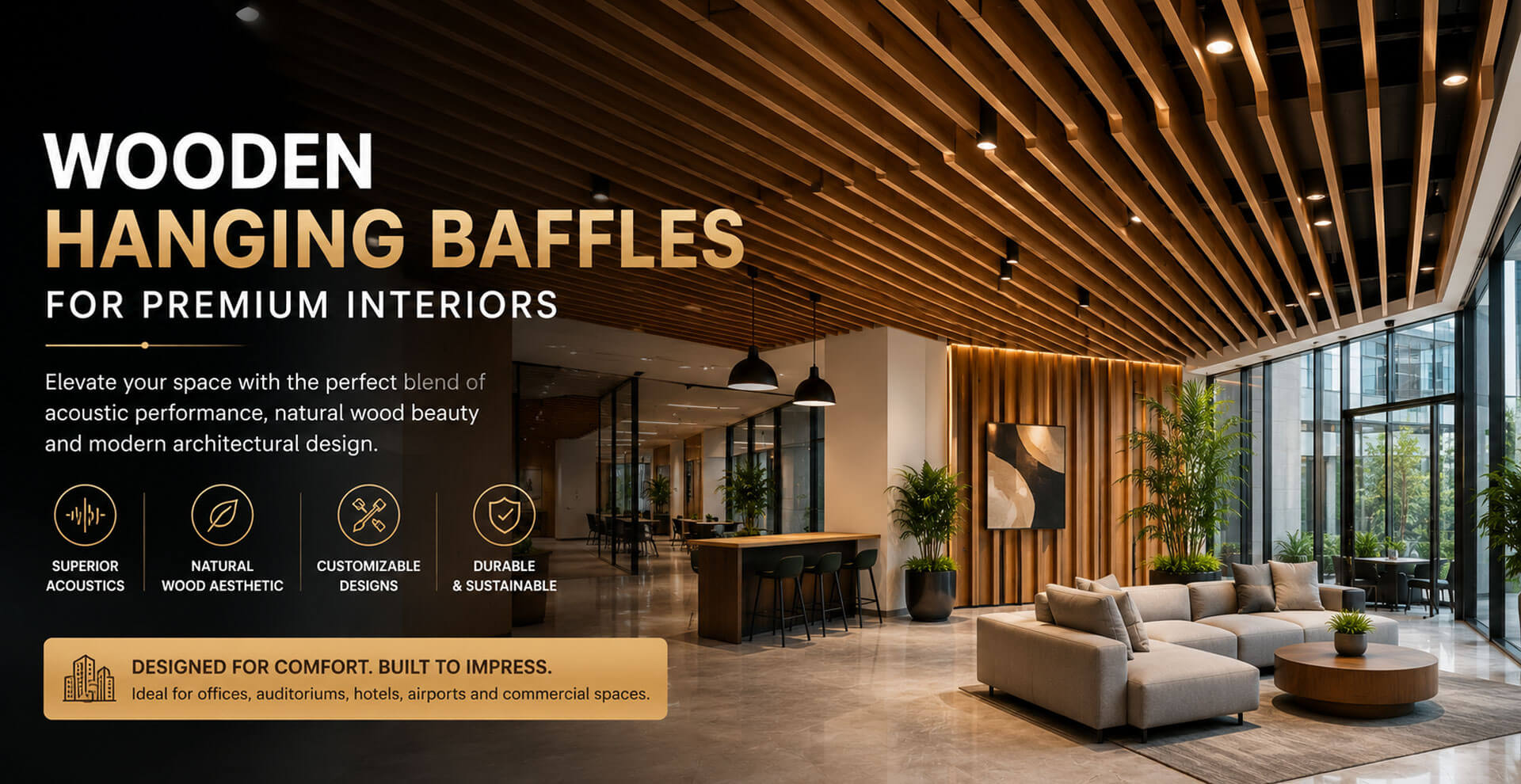
Wooden Hanging Baffles for Premium Interiors: Benefits, Design & Applications
In modern architecture, creating visually appealing spaces is only one part of successful interior design. Equally important is the acoustic comfort of the environment. Large open areas, exposed ceilings, glass partitions, concrete walls and minimalist designs often create excessive reverberation and unwanted noise. To solve these challenges while maintaining a sophisticated architectural appearance, designers increasingly choose wooden hanging baffles.
Wooden hanging baffles combine the warmth and elegance of natural wood with advanced acoustic performance. These suspended ceiling elements help absorb sound, reduce echo and enhance speech clarity while creating a premium visual impact. Today, they are widely used in corporate offices, auditoriums, universities, airports, hotels, restaurants and commercial buildings where both aesthetics and acoustics matter.
Unlike conventional acoustic systems that remain hidden, wooden acoustic baffles become an architectural feature themselves. Their vertical suspended design creates visual depth, defines ceiling spaces and delivers effective noise control without covering the entire ceiling structure.
Many projects integrate acoustic hanging baffles, wooden acoustic ceiling tiles, acoustical hanging clouds, ceiling acoustic panels and acoustic wall panels to create comprehensive acoustic treatment systems.
This complete guide explains everything about wooden hanging baffles, including their acoustic benefits, design options, applications, materials and installation considerations.
What Are Wooden Hanging Baffles?
Wooden hanging baffles are vertically suspended acoustic elements installed beneath ceilings to improve sound absorption and control reverberation. Unlike traditional ceiling panels that are mounted horizontally, baffles hang vertically, exposing both sides to sound waves and increasing their acoustic efficiency.
These systems typically consist of perforated wooden surfaces combined with acoustic backing materials such as fiberglass, mineral wool or polyester acoustic cores. The perforations allow sound waves to penetrate the surface and be absorbed by the internal acoustic material.
Wooden hanging baffles are available in numerous configurations, including:
- Linear wooden baffles
- Perforated timber baffles
- Decorative wooden acoustic fins
- Curved wooden baffle systems
- Custom architectural baffles
- Veneer finished acoustic baffles
The combination of natural wood aesthetics and acoustic functionality makes these systems highly attractive for premium interior projects.
How Wooden Acoustic Baffles Work
Sound behaves differently in modern architectural environments than many people realise. Every conversation, announcement, presentation or equipment noise generates sound waves that travel throughout a room.
When these sound waves encounter hard surfaces such as glass, concrete, marble and exposed ceilings, they reflect back into the space. These reflections continue bouncing between surfaces, creating reverberation and echo.
Excessive reverberation often results in:
- Poor speech intelligibility
- Increased background noise
- Reduced workplace productivity
- Acoustic discomfort
- Difficult communication
- Lower user satisfaction
Wooden hanging baffles interrupt these reflections by absorbing sound energy. The perforated wooden surface allows sound waves to enter the acoustic core where they are converted into minimal heat energy rather than reflecting back into the room.
Because baffles are suspended vertically, both sides remain exposed to sound waves. This increases the effective acoustic surface area and often provides better performance than flat ceiling-mounted systems alone.
This makes wooden acoustic baffles particularly effective in large open spaces with high ceilings.
Benefits of Wooden Hanging Baffles
Superior Acoustic Performance
The primary purpose of wooden hanging baffles is acoustic control. Their unique vertical configuration helps absorb reflected sound and reduce reverberation throughout the space.
High-quality wooden acoustic baffle systems achieve excellent sound absorption values, helping improve speech clarity and occupant comfort.
Premium Architectural Appearance
Wood is one of the most sought-after architectural materials because of its timeless appeal and natural warmth. Wooden baffles create a sophisticated ceiling design while simultaneously improving acoustics.
Architects often use timber acoustic baffles to create:
- Luxury office interiors
- High-end commercial spaces
- Premium hospitality projects
- Modern educational facilities
- Corporate headquarters
Open Ceiling Design Flexibility
Unlike traditional suspended ceilings, wooden hanging baffles preserve the openness of exposed ceilings. Mechanical services, lighting systems and architectural structures remain visible while acoustics are significantly improved.
This approach supports contemporary industrial and modern architectural styles without sacrificing acoustic comfort.
Improved Speech Intelligibility
Speech clarity is essential in offices, conference rooms, educational facilities and public spaces. Wooden acoustic baffles reduce reverberation and improve the intelligibility of conversations, presentations and announcements.
Reduced Noise Levels
By absorbing reflected sound energy, wooden hanging baffles help lower overall noise levels within a space. Occupants experience quieter and more comfortable environments that support concentration and communication.
Custom Design Possibilities
Wooden baffles can be manufactured in a wide range of:
- Colours
- Wood species
- Finishes
- Shapes
- Lengths
- Perforation patterns
This allows designers to align acoustic solutions with overall interior design concepts.
Sustainability Benefits
Many wooden acoustic products are manufactured using sustainable materials and environmentally responsible production processes. Projects pursuing green building certifications often benefit from incorporating timber-based acoustic solutions.
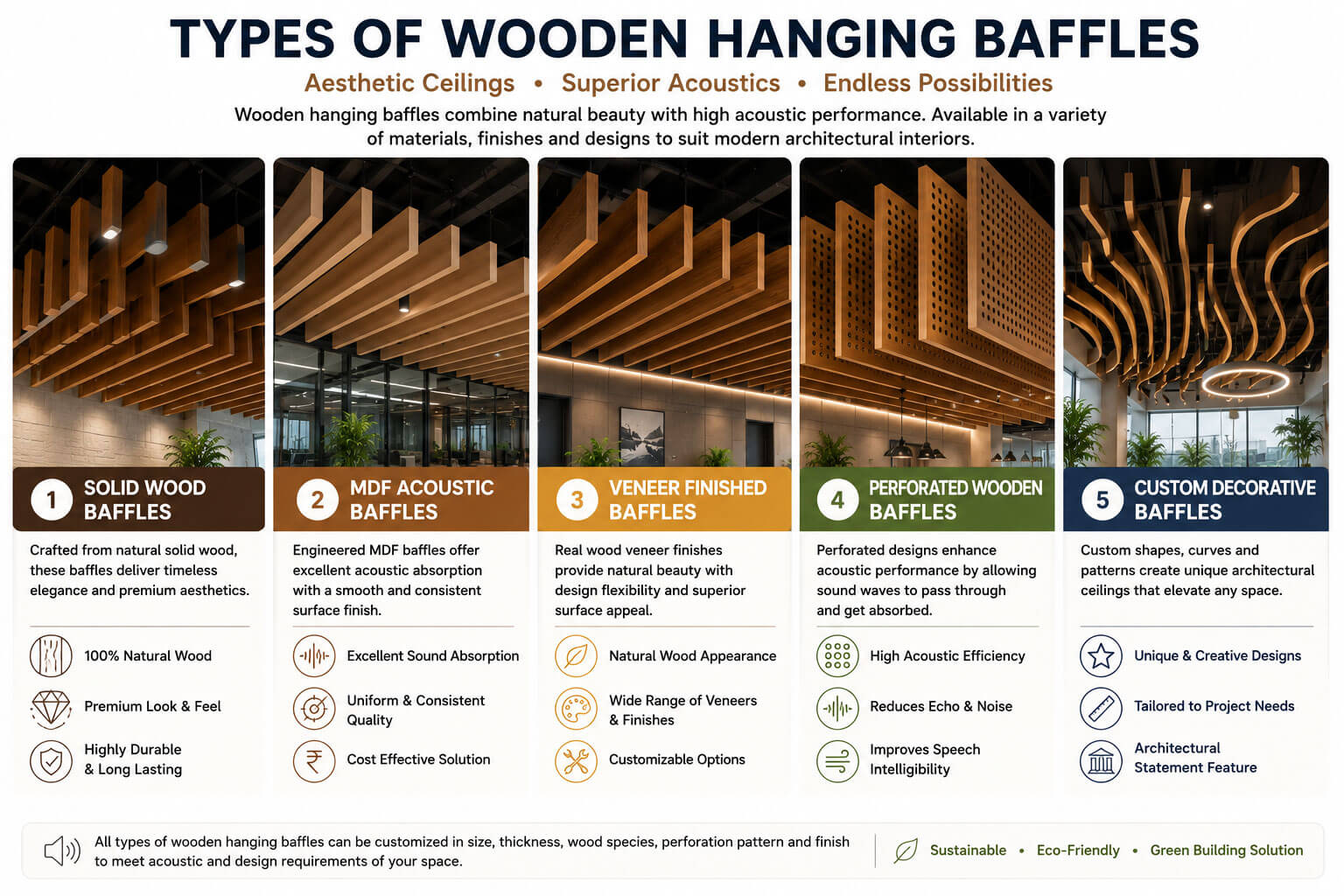
Types of Wooden Hanging Baffles
Solid Wood Baffles
Solid wood baffles provide the most authentic natural appearance. They are frequently used in luxury interiors where premium aesthetics are a priority.
Advantages include:
- Natural beauty
- High durability
- Long service life
- Premium appearance
MDF Acoustic Baffles
Medium-density fibreboard (MDF) acoustic baffles offer excellent consistency and acoustic performance while remaining cost-effective.
These systems are widely used in:
- Corporate offices
- Educational facilities
- Commercial projects
- Public buildings
Veneer Finished Acoustic Baffles
Veneer acoustic baffles combine engineered substrates with premium wood veneers. This provides the appearance of natural timber while maintaining manufacturing efficiency and design flexibility.
Decorative Acoustic Baffles
Custom decorative wooden baffles are designed specifically for architectural feature ceilings. They may include:
- Curved profiles
- Custom perforations
- Integrated lighting
- Unique geometric patterns
Popular Wood Finishes for Acoustic Baffles
One of the biggest advantages of wooden hanging baffles is the variety of finishes available.
- Natural Oak
- Walnut Finish
- Teak Finish
- Ash Wood Finish
- Maple Finish
- Custom Architectural Veneers
- Painted Finishes
- Laminate Wood Finishes
These finishes allow designers to coordinate acoustic treatments with flooring, furniture, wall finishes and overall interior themes.
Applications of Wooden Hanging Baffles
Wooden hanging baffles are among the most versatile acoustic ceiling solutions available today. Their combination of premium aesthetics and high acoustic performance makes them suitable for a wide range of commercial, institutional and hospitality projects. Whether the objective is reducing reverberation, improving speech clarity or creating a visually striking ceiling design, wooden acoustic baffles deliver outstanding results.
Corporate Offices
Modern offices increasingly feature open-plan layouts with exposed ceilings and collaborative workspaces. While visually appealing, these environments often experience excessive noise due to conversations, phone calls and equipment operation.

Wooden hanging baffles help:
- Reduce speech noise
- Improve employee concentration
- Enhance meeting room acoustics
- Create premium workplace environments
- Support employee wellbeing
Many corporate projects combine wooden baffles with ceiling acoustic panels and acoustic wall panels to achieve comprehensive acoustic treatment.
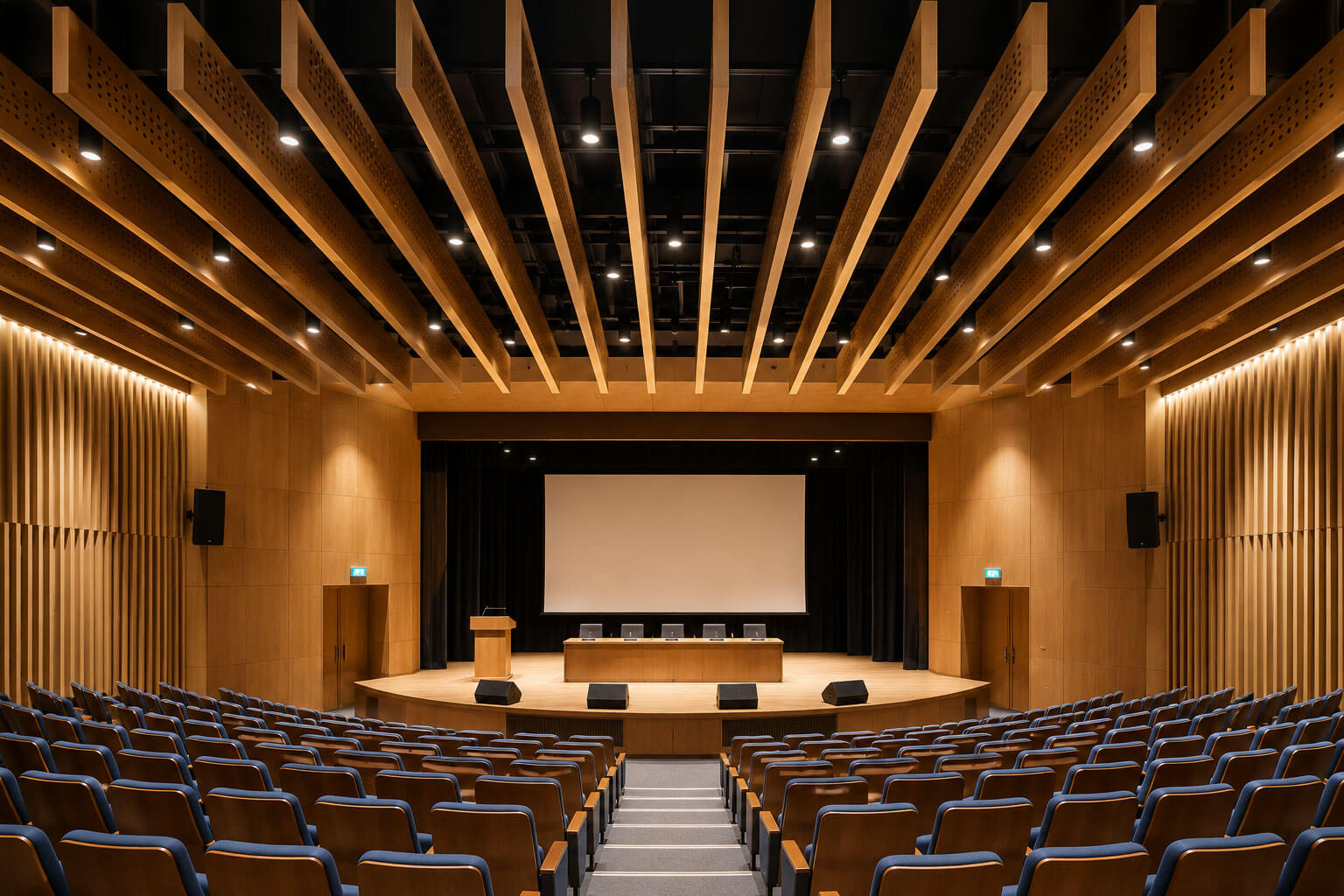
Auditoriums and Performance Spaces
Large auditoriums require carefully controlled acoustics to ensure balanced sound distribution and excellent speech intelligibility. Wooden acoustic baffles help control ceiling reflections while enhancing the overall acoustic environment.
They are commonly integrated into auditorium acoustic solutions and auditorium acoustic work projects.
Educational Institutions
Classrooms, lecture halls and universities benefit greatly from improved speech clarity. Research has consistently shown that poor acoustics negatively affect learning outcomes. Wooden acoustic baffles help create environments where students can clearly hear instructors and presentations.
Hotels and Hospitality Spaces
Hotels, banquet halls, restaurants and lounges require acoustic solutions that complement premium interior designs. Wooden hanging baffles provide both aesthetic elegance and acoustic comfort, helping guests enjoy quieter and more comfortable spaces.
Airports and Transportation Facilities
Large public buildings often suffer from excessive reverberation due to high ceilings and hard surfaces. Wooden acoustic baffles improve announcement clarity while reducing background noise levels.
Retail and Commercial Buildings
Retail spaces increasingly use acoustic treatments to improve customer experiences. Wooden ceiling baffles help create more comfortable environments while supporting modern architectural concepts.
Wooden Hanging Baffles vs Acoustical Hanging Clouds
Both wooden hanging baffles and acoustic clouds improve room acoustics, but they differ in design, installation and performance characteristics.
| Feature | Wooden Hanging Baffles | Acoustical Hanging Clouds |
|---|---|---|
| Orientation | Vertical | Horizontal |
| Architectural Style | Linear & Contemporary | Floating Ceiling Design |
| Visual Impact | Premium Timber Appearance | Modern Architectural Feature |
| Sound Absorption | Excellent | Excellent |
| Open Ceiling Compatibility | Very High | Very High |
| Best Applications | Offices, Airports, Universities | Conference Rooms, Auditoriums |
Many large projects combine acoustical hanging clouds with wooden baffles to optimize both acoustic performance and visual design.
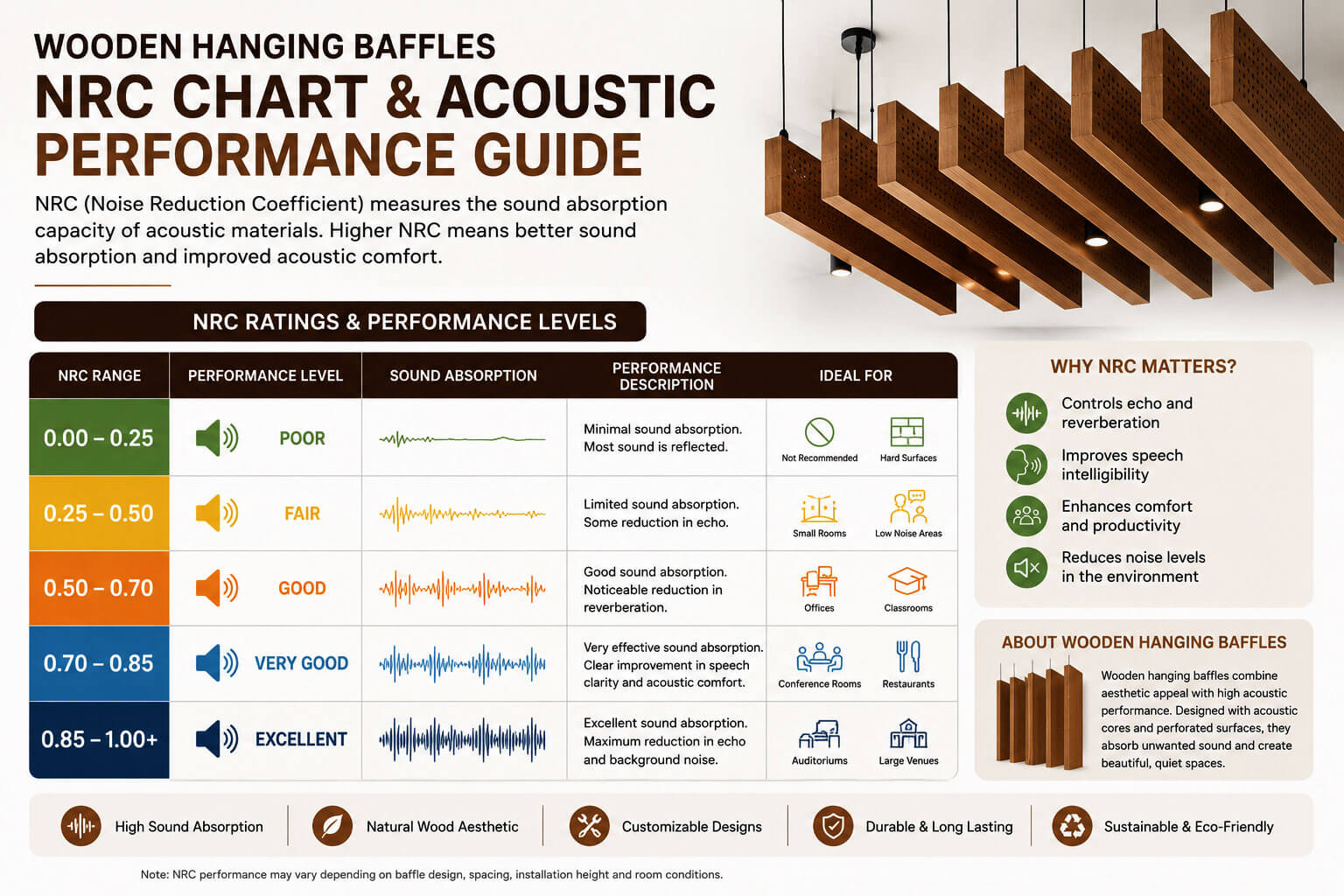
NRC Ratings and Acoustic Performance
The effectiveness of wooden acoustic baffles is commonly measured using the Noise Reduction Coefficient (NRC). This rating indicates the amount of sound energy absorbed by the acoustic system.
| NRC Rating | Performance Level |
|---|---|
| 0.50 | Moderate Sound Absorption |
| 0.70 | Good Acoustic Performance |
| 0.85 | High Acoustic Efficiency |
| 1.00+ | Excellent Sound Absorption |
Actual performance depends on:
- Perforation pattern
- Panel thickness
- Acoustic backing material
- Suspension height
- Baffle spacing
- Room geometry
High-performance wooden acoustic baffles can achieve NRC ratings exceeding 0.85 when combined with suitable acoustic backing materials.
Design Considerations Before Installation
To maximize acoustic performance and visual appeal, several factors should be considered during the design phase.
Room Volume
Larger rooms generally require greater acoustic coverage. Acoustic consultants often calculate reverberation times to determine the required number of baffles.
Ceiling Height
The height of the ceiling influences both acoustic performance and visual impact. Taller ceilings often benefit significantly from vertically suspended acoustic systems.
Noise Sources
Understanding the primary noise sources helps determine the most effective acoustic treatment strategy.
Architectural Intent
Wood species, finishes, spacing and suspension patterns should complement the overall interior design concept.
Lighting Integration
Many modern projects integrate lighting systems directly within wooden baffle arrangements to create dramatic architectural effects.
Installation Process of Wooden Hanging Baffles
Step 1: Acoustic Evaluation
Acoustic consultants assess the space to determine reverberation levels and treatment requirements.
Step 2: Design Development
Engineers establish baffle spacing, dimensions and suspension heights based on project objectives.
Step 3: Suspension System Installation
Support systems are installed using cables, rods or custom suspension hardware designed for long-term stability.
Step 4: Baffle Placement
Individual baffles are mounted and aligned according to approved shop drawings.
Step 5: Quality Inspection
The completed installation is inspected to verify appearance, safety and acoustic effectiveness.
Creating a Complete Acoustic Treatment Strategy
Although wooden hanging baffles are highly effective on their own, the best acoustic results often come from combining multiple acoustic solutions.
Recommended acoustic systems include:
- Acoustic Hanging Baffles
- Wooden Acoustic Ceiling Tiles
- Ceiling Acoustic Panels
- Ceiling Acoustic Tiles
- Acoustic Wall Panels
- Fabric Acoustic Panels
- Acoustical Hanging Clouds
- Auditorium Acoustic Solutions
This integrated approach helps create environments that are quieter, more comfortable and acoustically balanced.
Frequently Asked Questions About Wooden Hanging Baffles
What are wooden hanging baffles?
Wooden hanging baffles are vertically suspended acoustic elements designed to reduce reverberation and improve sound quality while enhancing architectural aesthetics.
Do wooden hanging baffles absorb sound?
Yes. The perforated wooden surface and acoustic backing materials work together to absorb sound energy and reduce unwanted reflections.
Where are wooden acoustic baffles commonly used?
They are widely used in offices, auditoriums, universities, hotels, airports, commercial buildings and premium interior spaces.
What is the NRC rating of wooden acoustic baffles?
Depending on design and acoustic backing, wooden baffles can achieve NRC ratings ranging from 0.70 to over 0.90.
Can wooden hanging baffles be customized?
Yes. They are available in custom lengths, finishes, perforation patterns, colours and wood species.
Are wooden baffles suitable for open ceilings?
Absolutely. Wooden baffles are specifically designed to improve acoustics while maintaining open ceiling architecture.
What is the difference between wooden baffles and ceiling clouds?
Wooden baffles are suspended vertically, while acoustic clouds are suspended horizontally. Both provide excellent sound absorption but create different architectural effects.
Conclusion
Wooden hanging baffles offer a unique combination of acoustic performance, architectural elegance and design flexibility. Their ability to reduce reverberation, improve speech clarity and enhance interior aesthetics makes them one of the most popular acoustic ceiling solutions for modern commercial and institutional projects.
Whether installed in offices, auditoriums, educational facilities, hospitality projects or transportation hubs, wooden acoustic baffles create environments that are quieter, more comfortable and visually impressive. When integrated with ceiling acoustic panels, acoustic wall panels and acoustical hanging clouds, they form part of a comprehensive acoustic strategy that delivers long-term performance and exceptional occupant experience.
Round-the-Clock Client Assistance
Creative Acoustic Designs
We deliver innovative acoustic solutions blending functionality and aesthetics, enhancing sound quality while elevating the visual appeal of any interior space.
Trusted Acoustic Safety
Our acoustic solutions ensure reliable safety, combining high-quality materials and expert installation to reduce noise hazards and protect every environment.