We provide 24/7 client support for all acoustic solutions, addressing queries, guidance, and service needs anytime, ensuring complete satisfaction.
Envirco Solutions - Architectural Acoustics Treatments & Noise Pollution Control Solution
We'are Open: Mon - Sat 9:00 - 19:00

- 24/7
Customer Service
- ISO 9001
Certification Company
- Qualified
Expert Professional

Sound Absorption with Hanging Baffles: Acoustic Baffle Systems Guide
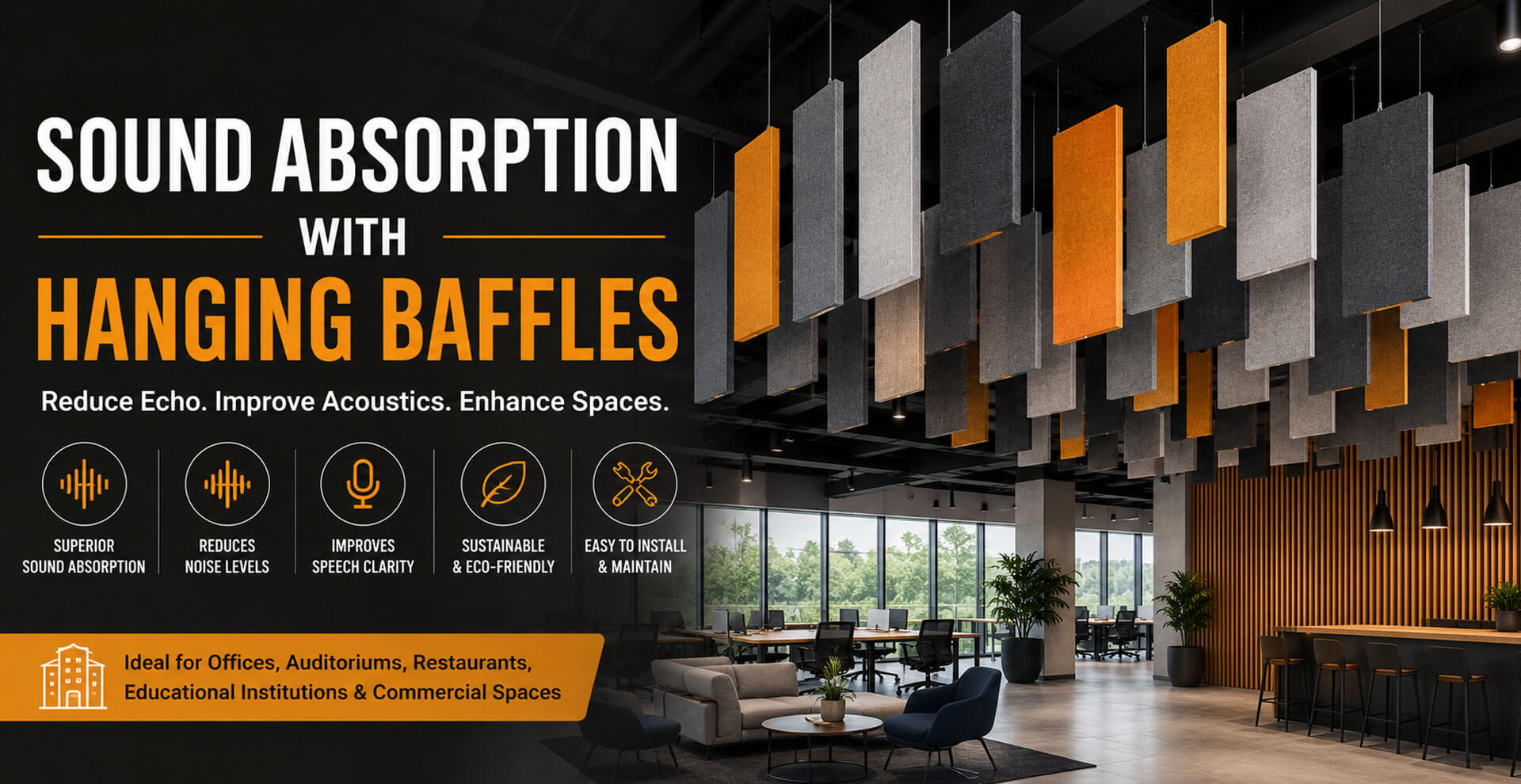
Sound Absorption with Hanging Baffles: Complete Guide to Acoustic Baffle Systems
Sound absorption with hanging baffles is a practical approach to controlling reverberation in large, open and acoustically reflective spaces. Rooms with high ceilings, exposed structures, glass, concrete, metal and other hard surfaces can allow sound to reflect repeatedly, making conversations less clear and increasing the sense of background noise.
Acoustic hanging baffles address this problem by introducing sound-absorbing surfaces into the upper volume of the room. Suspended from the ceiling or structural framework, these panels can be arranged vertically or at selected angles according to the geometry and acoustic requirements of the space. They are particularly useful where a conventional full-ceiling treatment is unsuitable or where additional absorption is required without covering the entire ceiling.
This guide explains how hanging baffles work, where they are used, the factors that influence their acoustic performance, installation considerations, NRC ratings, material options and how they can be combined with other acoustic treatments.
What Are Acoustic Hanging Baffles?
Acoustic hanging baffles are sound-absorbing panels suspended below a ceiling or structural soffit using cables, rods, brackets or other suspension hardware. Depending on the product and application, baffles may be installed vertically, horizontally or at an angle.
Their primary purpose is to absorb reflected sound energy and help control reverberation within the room. Unlike a conventional ceiling treatment that is generally mounted directly against the ceiling plane, suspended baffles introduce additional absorptive surfaces into the occupied volume of the space.
This makes them particularly relevant to buildings with exposed ceilings, large floor-to-ceiling heights or architectural layouts where extensive wall and ceiling coverage is difficult to achieve.
Hanging baffles can be manufactured using different acoustic constructions, including:
- Fabric-wrapped acoustic panels
- Polyester and PET acoustic materials
- Fiberglass acoustic cores
- Mineral wool acoustic materials
- Wood-based acoustic constructions
- Metal systems incorporating acoustic infill
The actual acoustic performance depends on the construction of the baffle, its absorptive material, exposed surface area, installation configuration and the acoustic characteristics of the complete room.
How Does Sound Absorption with Hanging Baffles Work?
When people speak, machinery operates or other sounds are produced inside a room, sound waves travel through the space and interact with walls, ceilings, floors, furniture and other surfaces. Hard, reflective surfaces return a large proportion of sound energy back into the room.
When these reflections continue for a period of time, they contribute to reverberation. Excessive reverberation can make speech harder to understand and can increase the perceived loudness of activity within the space.
Hanging baffles introduce absorptive surfaces into the path of reflected sound. When sound energy reaches an appropriate absorptive material, part of that energy is converted into a small amount of heat within the material rather than being reflected back into the room.
Because suspended baffles can expose absorptive faces on multiple sides, their orientation and spacing can be used as part of the overall acoustic design. However, the performance of a baffle system should not be judged simply by the number of exposed faces. Material construction, dimensions, spacing, suspension height, room geometry and the amount of installed absorption all influence the result.
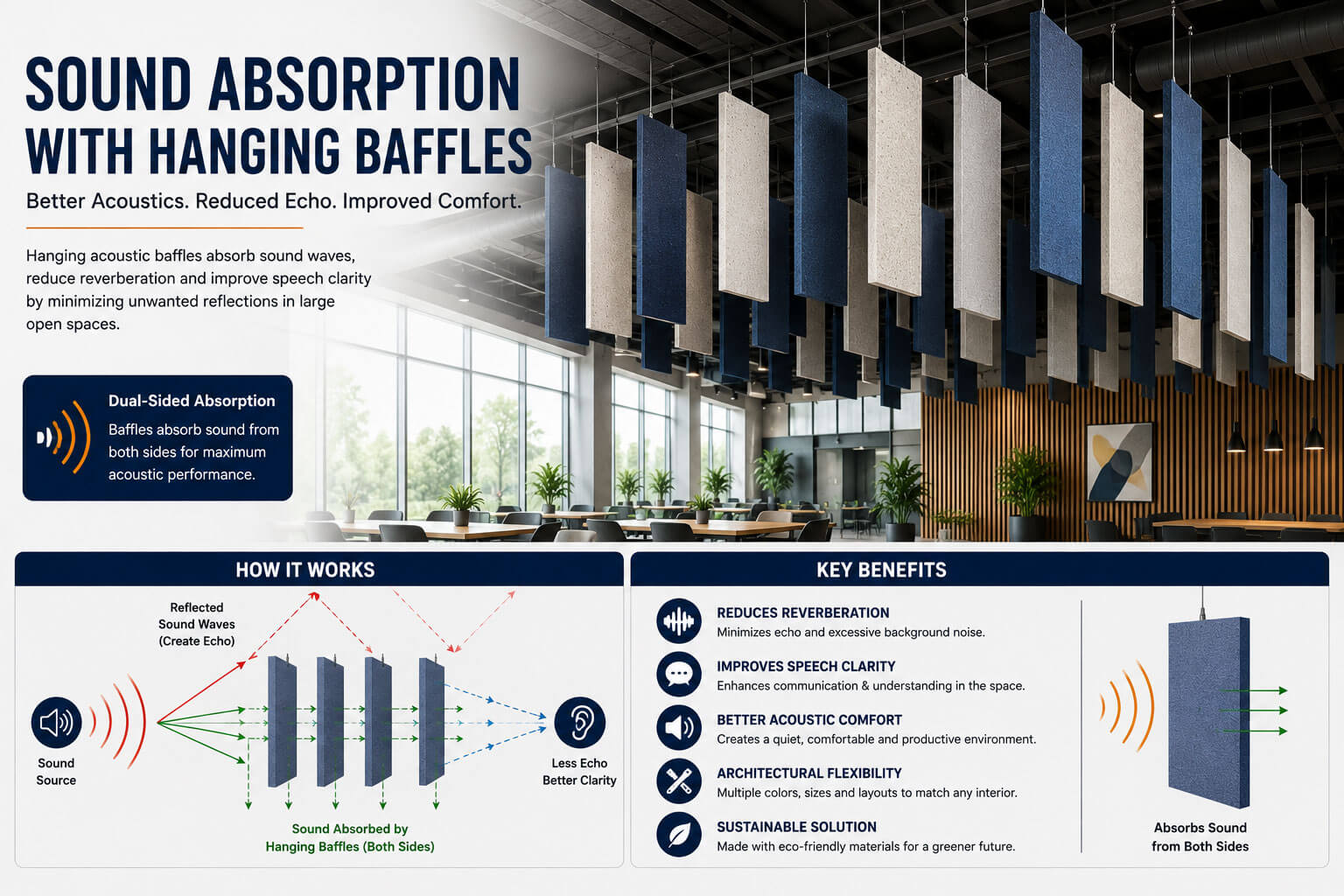
Suspended acoustic baffles introduce sound-absorbing surfaces into large open spaces and help control reflected sound.
Why Are Hanging Baffles Useful in Large Spaces?
Large rooms can have substantial air volume and long sound reflection paths. High ceilings and exposed building structures can also limit the amount of conventional acoustic treatment that can be installed directly on the ceiling.
Suspended baffles provide another way of adding absorption to the room. Rather than relying entirely on the ceiling plane, acoustic treatment can be distributed through selected areas of the upper room volume.
This approach can be useful when designing acoustics for:
- Large open-plan offices
- Auditoriums and multipurpose halls
- Schools and lecture rooms
- Factories and industrial buildings
- Sports halls and indoor recreation spaces
- Restaurants and hospitality areas
- Transportation and public buildings
- Large commercial interiors
Key Benefits of Acoustic Hanging Baffles
Helps Control Reverberation
One of the main purposes of hanging baffles is to add sound absorption to rooms where reflections contribute to excessive reverberation. Reducing reflected sound can help create a more controlled acoustic environment.
Supports Better Speech Intelligibility
In offices, classrooms, meeting rooms and other communication-focused spaces, excessive reverberation can make speech less distinct. Appropriate acoustic treatment can reduce unwanted reflections and support clearer communication.
Suitable for High or Exposed Ceilings
Suspended baffles can be particularly useful where ceilings are high, open or architecturally exposed. They provide additional absorptive surfaces without necessarily requiring the entire ceiling to be covered.
Flexible Layout Options
Baffles can be arranged in rows, grids, clusters or other patterns depending on the room layout and design requirements. Their spacing and orientation can also be considered during acoustic planning.
Combines Acoustic Treatment with Interior Design
Many modern baffle systems are available in different colours, dimensions, shapes and finishes. This allows acoustic treatment to become part of the interior design rather than appearing as an independent technical element.
Where Are Acoustic Hanging Baffles Used?
Corporate Offices
Open-plan workplaces can contain large numbers of reflective surfaces and multiple simultaneous conversations. Suspended acoustic treatment can help manage reverberation and improve the overall acoustic environment while retaining an open ceiling appearance.
Auditoriums and Multipurpose Halls
Auditoriums and halls often require carefully controlled reverberation because speech, presentations and amplified sound need to remain intelligible. Hanging baffles may form one part of a wider auditorium acoustic solution.
Schools and Educational Buildings
Classrooms, lecture halls and common areas benefit from controlled reverberation because students need to understand spoken instructions clearly. Baffles can be incorporated into rooms where conventional ceiling treatment is limited.
Factories and Industrial Facilities
Industrial buildings can contain large volumes, metal surfaces and exposed structures that contribute to sound reflections. Acoustic baffles can provide additional absorption as part of a broader workplace acoustic strategy.
Restaurants and Cafes
Busy dining spaces can become acoustically uncomfortable when conversations, kitchen activity and other sounds are repeatedly reflected from hard surfaces. Suspended absorption can help create a more comfortable environment for conversation.
Sports and Recreation Facilities
Gymnasiums and indoor sports halls often have large volumes and highly reflective construction. Hanging baffles can help manage reverberation while maintaining the functional requirements of the space.
Types of Acoustic Hanging Baffles
The appropriate baffle construction depends on the required acoustic performance, visual design, durability, fire requirements, maintenance conditions and installation environment.
Fabric-Wrapped Acoustic Baffles
Fabric-wrapped baffles typically combine an absorptive acoustic core with a decorative fabric finish. They are commonly used in offices, educational environments, meeting spaces and other interiors where both acoustic performance and appearance are important.
Polyester and PET Acoustic Baffles
Polyester and PET-based acoustic products are available in a variety of shapes, colours and thicknesses. Their lightweight construction can provide flexibility for suspended ceiling applications and contemporary interior designs.
Wooden Acoustic Baffles
Wood-based baffle systems can combine architectural detailing with acoustic treatment. Depending on their construction, perforation, slotting, backing and cavity arrangement, they can provide sound absorption while creating a timber-based interior finish.
Metal Acoustic Baffles
Metal baffle systems can be used in commercial and architectural environments where durability and a structured ceiling appearance are important. Acoustic performance generally depends on the use of suitable absorptive backing or infill within the system.
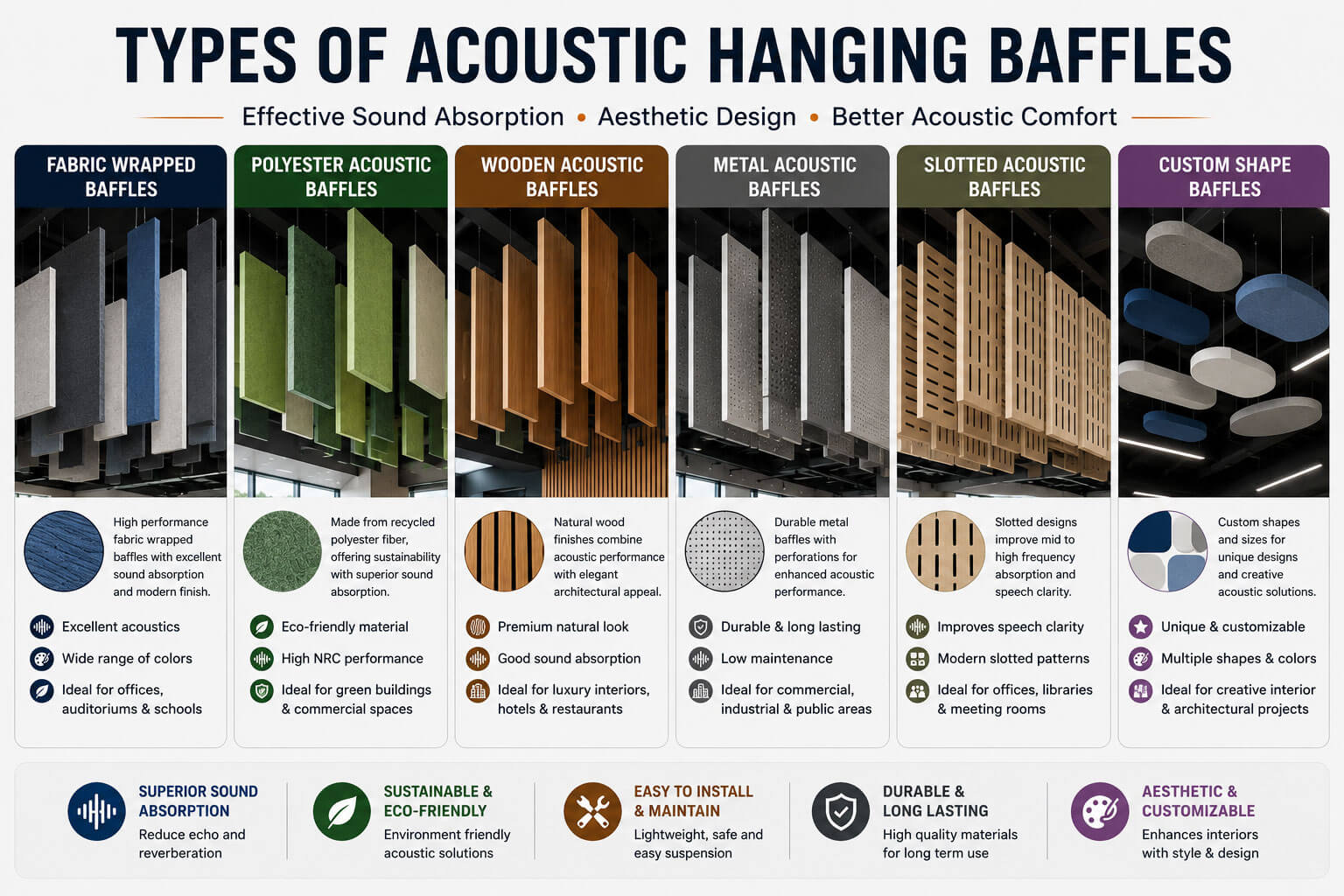
Different hanging baffle constructions can be selected according to acoustic, architectural and installation requirements.
Factors That Affect Hanging Baffle Performance
There is no single baffle arrangement that is suitable for every room. Acoustic performance depends on the interaction between the baffles and the room itself.
Baffle Surface Area
The amount of absorptive material introduced into the room is an important consideration. Increasing the effective absorptive area can influence the overall acoustic response, although the required quantity depends on room volume, existing absorption and the desired acoustic conditions.
Spacing Between Baffles
The distance between individual baffles affects how sound interacts with the absorptive surfaces. Closely spaced and widely spaced arrangements can produce different acoustic outcomes and should be considered together with room geometry.
Orientation
Vertical, horizontal and angled arrangements expose the absorptive surfaces to sound from different directions. Orientation should therefore be selected according to the room layout and the locations of important sound sources and listeners.
Ceiling Height
Ceiling height influences the distance between the baffles, the occupied zone and the building structure. High-volume spaces often require a carefully planned suspension height rather than simply installing the baffles as close as possible to the ceiling.
Existing Room Surfaces
Walls, floors, ceilings, glazing, furniture and other surfaces all contribute to the acoustic behaviour of a room. Hanging baffles should therefore be considered as part of the complete acoustic treatment rather than as an isolated product.
Acoustic Performance and NRC Ratings
The Noise Reduction Coefficient (NRC) is commonly used to describe the sound absorption performance of an acoustic material or system. It is based on laboratory absorption measurements and provides a useful way to compare tested products under defined conditions.
However, an NRC value should not be treated as a guarantee of the acoustic performance of an entire room. The final result depends on the quantity of installed material, mounting configuration, spacing, orientation, room dimensions and existing acoustic surfaces.
For this reason, there is no universal NRC rating that should be specified for every hanging baffle project. Product selection should be based on the manufacturer's tested acoustic data and the requirements of the particular room.
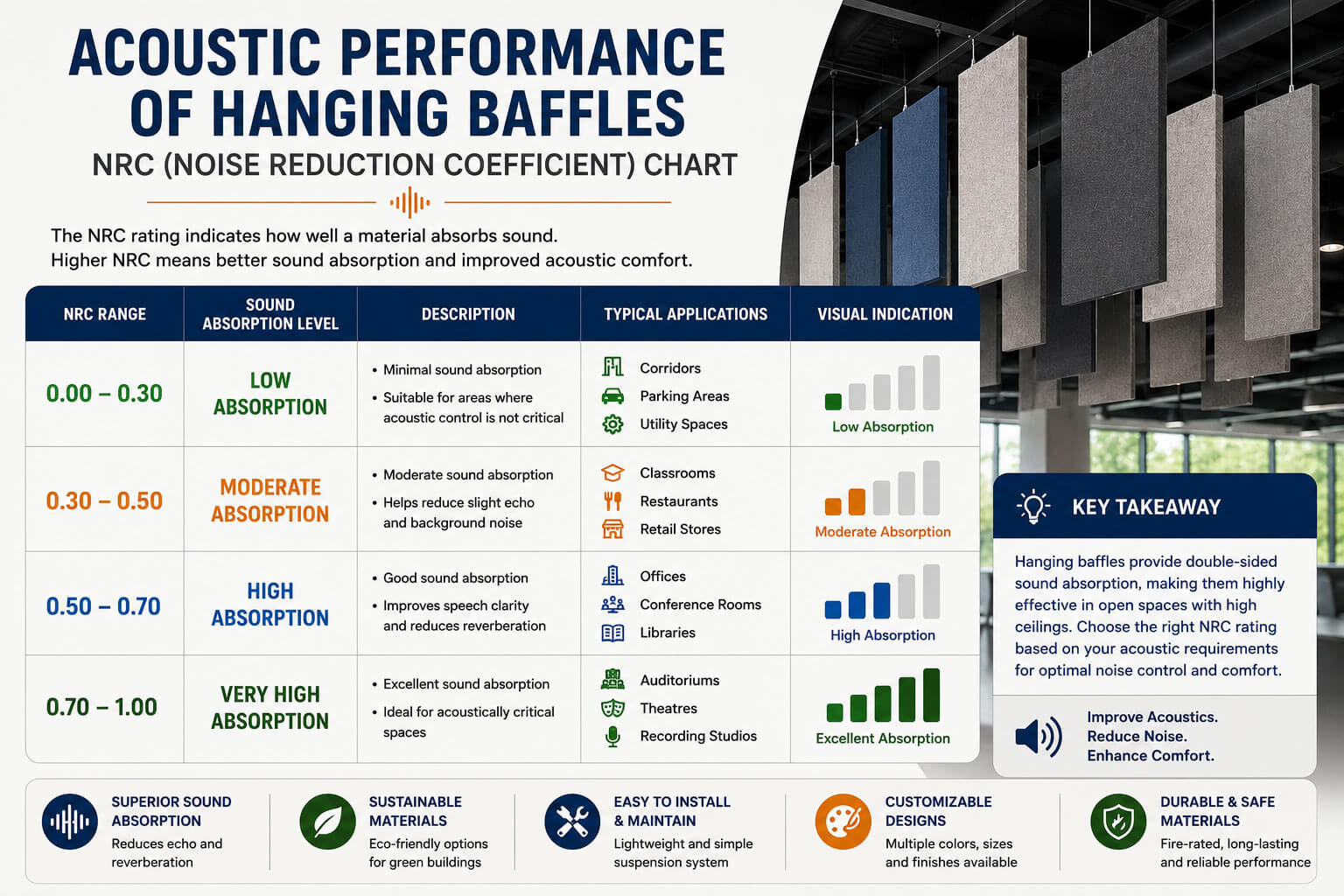
NRC is one of the acoustic performance indicators that can be reviewed when comparing tested baffle systems.
Sound Absorption vs Sound Insulation
Sound absorption and sound insulation address different acoustic problems and should not be treated as interchangeable terms.
Sound absorption reduces reflected sound energy within a room. Hanging baffles are primarily used for this purpose, particularly when the objective is to control reverberation and improve acoustic comfort.
Sound insulation, on the other hand, concerns the reduction of sound transmission from one space to another through walls, floors, ceilings, doors and other building elements.
Therefore, installing hanging baffles inside a room should not automatically be described as soundproofing the room or preventing sound from passing through a partition. If the project requires sound isolation between spaces, the building construction and separating elements need to be assessed separately.
Hanging Baffles vs Ceiling Acoustic Panels
Both hanging baffles and ceiling-mounted acoustic panels can be used to introduce sound absorption into a room, but their installation methods and design possibilities are different.
| Feature | Hanging Baffles | Ceiling Acoustic Panels |
|---|---|---|
| Installation | Suspended below the ceiling or structure | Usually mounted directly to or near the ceiling |
| Open Ceiling Compatibility | Well suited to exposed ceiling environments | Depends on the ceiling construction and mounting method |
| Orientation | Can be vertical, horizontal or angled depending on system | Generally follows the ceiling plane |
| Layout Flexibility | Individual baffles can be arranged in different patterns | Usually installed as individual ceiling-mounted units or a planned ceiling layout |
| High Ceiling Applications | Can introduce absorption within the upper room volume | Performance depends on ceiling height and mounting configuration |
The appropriate system depends on room geometry, architectural requirements and the amount and location of sound absorption needed. In some projects, suspended baffles can also be combined with ceiling acoustic panels and wall treatments.
Installation of Acoustic Hanging Baffles
A successful hanging baffle installation requires more than simply suspending panels from the ceiling. The layout should consider the room dimensions, ceiling height, structural conditions, lighting, HVAC services, sprinklers and other building elements.
A typical installation process may include:
- Acoustic assessment: Identify the room's reverberation, noise and speech-related requirements.
- Room and ceiling survey: Review dimensions, structural elements, services and available suspension points.
- Acoustic layout planning: Determine the number, dimensions, spacing and orientation of the baffles.
- Suspension planning: Select appropriate cables, rods, brackets or other hardware according to the system.
- Baffle installation: Position and secure the panels according to the approved layout.
- Final inspection: Check alignment, stability, clearances and integration with other building services.
Suspension hardware should always be selected and installed according to the manufacturer's requirements and the structural conditions of the building.
How to Select the Right Hanging Baffle System
The right acoustic baffle should be selected according to the acoustic objective rather than appearance alone. Before specifying a system, consider the following factors:
- Room function: Offices, classrooms, auditoriums and industrial areas have different acoustic requirements.
- Room volume: Larger rooms generally require a different treatment strategy from smaller enclosed spaces.
- Ceiling height: Suspension height can affect the position and effectiveness of the absorptive surfaces.
- Required absorption: Review tested acoustic data for the proposed product and mounting configuration.
- Material and finish: Select a construction appropriate for the interior design and maintenance conditions.
- Fire and safety requirements: Confirm the applicable project and building requirements before specification.
- Suspension method: Check structural support, hardware requirements and coordination with building services.
- Existing acoustic treatment: Consider walls, ceilings, floors and other absorptive surfaces already present.
Common Mistakes When Using Hanging Baffles
Selecting Baffles Only by Appearance
A visually attractive baffle may not provide the acoustic performance required for a particular room. Tested acoustic data and system construction should be reviewed before specification.
Ignoring Room Geometry
The number and arrangement of baffles should relate to the room's dimensions, ceiling height and reflective surfaces. Using a standard layout without considering the room can produce inconsistent results.
Treating Absorption as Soundproofing
Hanging baffles primarily control sound reflections within a room. They should not be presented as a replacement for sound-isolating walls, ceilings, doors or partitions.
Using Generic NRC Values
Acoustic performance should be based on tested product data rather than assuming that every baffle with a particular material or thickness has the same absorption characteristics.
Failing to Coordinate with Building Services
Lighting, air-conditioning, sprinklers, electrical services and structural elements can affect the final baffle layout. Coordination should be completed before installation.
Combining Hanging Baffles with Other Acoustic Treatments
Hanging baffles are often most effective when they form part of a coordinated room acoustic strategy. Depending on the project, additional treatments may be required on walls, ceilings or other reflective surfaces.
- Acoustic Hanging Baffles for suspended sound absorption applications
- Ceiling Acoustic Panels for ceiling-mounted absorption
- Ceiling Acoustic Tiles for integrated ceiling treatment
- Acoustic Wall Panels for reducing reflections from wall surfaces
- Fabric Acoustic Panels for wall and architectural acoustic applications
- Acoustical Hanging Clouds for suspended horizontal or shaped acoustic treatments
- Auditorium Acoustic Solutions for larger performance and multipurpose spaces
The combination of treatments should be determined according to the room's acoustic requirements rather than simply adding as many absorptive products as possible.
Frequently Asked Questions About Hanging Baffles
What are acoustic hanging baffles?
Acoustic hanging baffles are suspended sound-absorbing panels used to reduce reflected sound and help control reverberation in interior spaces. They can be installed vertically, horizontally or at an angle depending on the system and room requirements.
How do hanging baffles absorb sound?
When sound energy reaches the absorptive surfaces of a baffle, part of that energy is absorbed by the acoustic material instead of being reflected back into the room. Performance depends on the material, construction, exposed area, spacing, orientation and installation arrangement.
Where are acoustic hanging baffles commonly used?
Hanging baffles are used in offices, auditoriums, educational buildings, factories, sports facilities, restaurants, public buildings and other large interior spaces where reverberation and reflected sound need to be controlled.
Do hanging baffles reduce echo?
Hanging baffles can help reduce echo and reverberation by adding sound-absorbing surfaces to a room. The degree of improvement depends on room size, existing reflective surfaces, the amount of acoustic treatment and the arrangement of the baffles.
What NRC rating should acoustic baffles have?
There is no single NRC rating that is suitable for every application. The appropriate product should be selected using tested acoustic data together with the room's size, function, existing absorption and required acoustic performance.
Are hanging baffles suitable for high ceilings?
Yes. Hanging baffles can be useful in rooms with high or exposed ceilings because they introduce absorptive surfaces below the structural ceiling without requiring complete ceiling coverage. The suspension height and layout should be planned according to the room and product requirements.
Can acoustic hanging baffles be customised?
Depending on the manufacturer and system, acoustic baffles may be available in different sizes, shapes, colours, finishes, orientations and suspension configurations. Customisation should be evaluated against the acoustic and installation requirements of the project.
What is the difference between hanging baffles and ceiling acoustic panels?
Hanging baffles are suspended below the ceiling and can expose absorptive surfaces on multiple sides. Ceiling acoustic panels are generally mounted directly to or near the ceiling plane. The appropriate option depends on the room geometry, ceiling construction, acoustic requirements and desired design.
Conclusion
Sound absorption with hanging baffles can be an important part of acoustic planning for large, open and reflective spaces. By introducing absorptive surfaces into the upper volume of a room, suspended baffles can help control reverberation, support speech intelligibility and improve overall acoustic comfort.
Their performance depends on more than the baffle material alone. Room volume, ceiling height, baffle dimensions, surface area, spacing, orientation, mounting configuration and existing acoustic treatment all need to be considered when planning a system.
For this reason, hanging baffles should be specified as part of a complete acoustic strategy rather than selected solely on appearance or a single performance figure. When appropriately designed and coordinated with other acoustic treatments, they can provide a practical and architecturally flexible approach to sound absorption.
Round-the-Clock Client Assistance
Creative Acoustic Designs
We deliver innovative acoustic solutions blending functionality and aesthetics, enhancing sound quality while elevating the visual appeal of any interior space.
Trusted Acoustic Safety
Our acoustic solutions ensure reliable safety, combining high-quality materials and expert installation to reduce noise hazards and protect every environment.